
The weather on La Palma isn’t really a single type of weather at all. It’s a stack of climate zones layered on top of one another, and the higher you climb, the less accurate the coastal forecast becomes.
Visitors who check the temperature for the capital and pack accordingly are often surprised the moment they head into the Northwest Highlands, where a different set of rules applies.
Understanding the weather on La Palma at 1,380 meters means understanding how a single small island can support so many climate zones at the same time, and why this specific elevation in the northwest is in such a favorable location.
How a Single Island Can Be Home to So Many Climate Zones
La Palma rises steeply from the Atlantic Ocean to over 2,400 meters at Roque de los Muchachos. Packing such a large elevation difference into such a small landmass creates something unusual: distinct climate zones stacked vertically, each just a short drive from the next. As a result, the weather on La Palma changes more with altitude than with the calendar.
Near the coast, the air tends to be warm and humid. A few hundred meters higher up, you enter the zone where trade wind clouds gather. Above that, the air becomes cool, dry, and clear. This vertical zoning is why two people on the same island, on the same day, can describe completely different weather conditions.
The east coast may be cloudy, while the northwestern highlands are bathed in sunshine. If you want to understand the weather on La Palma, you must first abandon the idea of a single, island-wide forecast. For a broader picture of the island’s geography and how elevation shapes it, the page “Canary Island: La Palma” provides useful context.
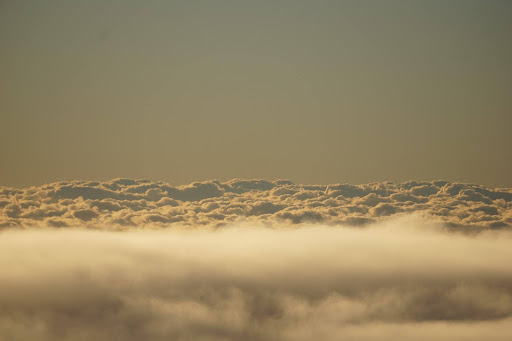
The Inversion Layer, Simply Explained.
The mechanism behind this layered weather pattern on La Palma is the trade wind inversion, and once you understand it, the whole island makes more sense.
Normally, air cools as it rises. But over the Canary Islands, trade winds push moist air in from the northeast, and a layer of warmer, drier air settles on top of it. This warm cap traps the cooler, moister air beneath it, which condenses into a stable band of clouds.
The result is a kind of layer that typically forms between 600 and 1,500 meters on the windward side. Below this layer, it is humid and often overcast. Above it, the sky is clear and the air is dry.
The cloud does not rise through the inversion layer, so the boundary remains remarkably constant. This single characteristic explains most of how the weather on La Palma behaves and why altitude is the most important variable.
Why 1,380 Meters Is the Optimal Point
Altitude alone isn’t the whole story. Your location relative to this inversion layer determines your daily weather on La Palma, and 1,380 meters on a southwest-facing northwest slope puts you in an unusually good spot.
At this altitude, in a place like the Hacienda La Palma winery, you’re usually right at the upper edge of the cloud layer or just above it. That means the clouds form a ceiling beneath you rather than all around you. You get the sun earlier in the day and keep it longer, while lower elevations remain gray.
The northwest is also partially shielded from the strongest flow of moisture, which is why this area often clears up even when the windward east is overcast.
The humidity is low, so warm afternoons are pleasant and cool evenings feel crisp rather than damp. The trade-off is stronger UV radiation, since there is less atmosphere and less filtering above you—a well-documented effect of higher altitude.
The page “High-Altitude Air and Microclimate” describes how this altitude affects air quality, sleep, and daily comfort. In practical terms, the weather on La Palma at 1,380 meters offers more usable sunshine than almost anywhere else on the island.
Reading the Sky: Daily Weather Patterns in the Northwest
Once you understand how it works, you can check the daily weather in northwest La Palma instead of relying on a forecast written for the coast.
A typical highland morning starts out cool and sometimes cloudy, since the temperature inversion is low overnight. By mid-morning, the clouds often drop or dissipate, and clear sunshine prevails for the rest of the day. Keep an eye on the cloud line: if it’s well below your terrace, you’re in for a bright day; if it creeps up the slope, expect a milder, cooler one.
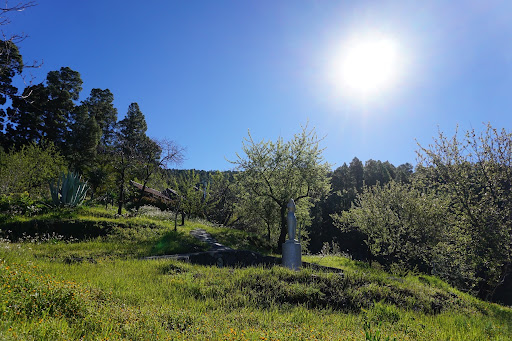
After rain that comes in short bursts rather than as a long, steady drizzle, the air becomes exceptionally clear, and the light at this altitude becomes brilliant. The Calima, a hot, dusty wind from the Sahara, is the main disruptive factor; it causes temperatures to spike and turns the sky hazy and golden for a few days.
Learning these patterns will tell you more about the weather on La Palma than any app, because the local sky is the most reliable forecast you have.
Planning Your Days Around the Microclimate
The real value of understanding La Palma’s weather is that you can plan around its microclimate instead of being caught off guard by it.
The cool, dry mornings at high altitudes are nearly ideal for hiking. Starting early means you’ll be ascending before the afternoon sun gets too strong on exposed ridges, and trails on volcanic soil dry quickly after rain.
The “ Hiking on La Palma ” page lists routes that start right in the northwest. For everything else, the rule of thumb is simple: plan for a temperature difference of 10 to 12 degrees between the midday sun and the terrace after sunset; take UV protection seriously even on mild days; and use the cloud line as your daily guide.
The clear, stable nights are also the reason why the northwest is one of the best stargazing regions in Europe, because the same dry, still air that clears the daytime sky ensures exceptional clarity after dark. Using the La Palma map, you can map out elevation zones and plan excursions through different climate zones.

Frequently Asked Questions (FAQs)
1. Why Is the Weather on La Palma So Different Between the Coast and the Highlands?
Because of the trade wind inversion. A layer of warm air traps cooler, moist air beneath it, forming a band of clouds. Below this band, it is humid and overcast; above it, the sky is clear. The weather on La Palma therefore depends far more on elevation than on the season.
2. How many sunny days does the Northwest have at an elevation of 1,380 meters?
The Northwest Highlands enjoy over 300 days of sunshine a year. Being above the cloud line means more usable sunshine than on the coast, even during the cooler months. Rain does occur, but it usually falls in short, intense bursts rather than all day long.
3. Does the microclimate make it cold at 1,380 meters?
More cool than cold. Daytime temperatures rarely drop below 14 degrees even in the coolest months, while summer days range from about 20 to 26 degrees. At night in winter, temperatures can drop to 8 or 9 degrees, which is why traditional stone houses with fireplaces are so well suited to the weather in the La Palma highlands.
4. What Is Calima, and Should I Be Worried?
The Calima is a hot, dry wind that carries fine Saharan dust over the Canary Islands. It causes temperatures to spike and turns the sky hazy and golden. These events are usually brief, lasting only a few days, and are an occasional rather than a constant feature of La Palma’s weather.
5. How can I tell what the weather will be like in the highlands on a given day?
Watch the cloud line. If the cloud is clearly below your terrace, expect a bright, clear day. If it climbs up the slope, the day will be cooler and milder. After rain, the visibility is often the clearest you’ll find anywhere, which makes the weather in the La Palma highlands especially rewarding for views and photography.
Once you understand the inversion layer and know why 1,380 meters is where it is, the weather on La Palma will no longer be unpredictable—it will become easy to understand. In the northwestern highlands, this means more sunshine, clearer nights, and a microclimate that rewards anyone who learns to live according to the cloud line.